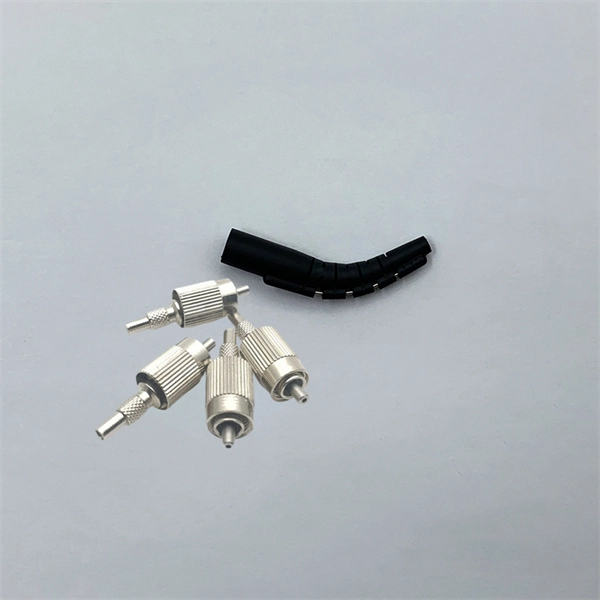
Fiber gratings are periodic structures inscribed in optical fibers that selectively reflect or filter specific wavelengths of light, enabling applications in sensing and telecommunications.
Overview of Optical Fibers
Optical fibers are thin strands of glass or plastic designed to transmit light over long distances with minimal loss. The core of the fiber guides light, while the cladding surrounds it to maintain total internal reflection. Integrating gratings into these fibers allows precise control over light propagation, enhancing signal quality and enabling wavelength-specific filtering.
Fiber Gratings
A fiber grating is a segment of optical fiber where the refractive index of the core is periodically modified. This periodic structure acts as a wavelength-specific reflector or filter. When light travels through the fiber, most wavelengths pass through, but those matching the grating's periodicity are reflected or coupled into the cladding, depending on the grating type.
Types of Fiber Gratings
Fiber Bragg Grating (FBG)FBGs have short, uniform periodic structures, typically a few millimeters long. They reflect a narrow band of wavelengths while transmitting others, functioning as precise mirrors for specific light colors.
FB
Gs are widely used in telecommunications for signal processing and in structural health monitoring, as they are sensitive to strain and temperature changes.
Long-
Period Grating (LPG)LPGs have longer grating periods, often hundreds of micrometers. Instead of reflecting light, LPGs couple specific wavelengths from the core into the cladding, effectively removing them from the main signal.
LP
Gs are commonly used in sensing applications, such as detecting refractive index changes or environmental parameters.
Fabrication Techniques
Fiber gratings are typically created by exposing a photosensitive fiber core to ultraviolet (UV) laser light.
The U
V light induces a permanent periodic variation in the refractive index. Techniques include transverse holographic inscription and phase mask methods, which allow precise control over the grating period and properties.
Applications
Telecommunications: FBGs act as inline filters, wavelength-specific reflectors, or mirrors in fiber lasers. Sensing: Both FBGs and LPGs detect strain, temperature, pressure, and refractive index changes. Their small size, light weight, and immunity to electromagnetic interference make them ideal for embedding in structures or materials.
Optical Signal Processing: Gratings can manage dispersion, filter signals, and improve signal quality in fiber-optic networks.
Key Principles
The operation of fiber gratings relies on Fresnel reflection and phase matching. Light encountering alternating refractive indices is partially reflected at each interface. When the Bragg condition is satisfied, reflected waves add constructively, producing strong reflection at specific wavelengths.
In summary, fiber gratings transform standard optical fibers into versatile devices capable of precise wavelength control, enabling advanced applications in communications, sensing, and photonics.